What Size Boiler Do I Need for My Home?
Boiler size is measured in kilowatts (kW), which describes the boiler's output. The right figure for your home depends on the type of boiler, how much heat your property loses, how many bathrooms you have and, for combi boilers, the flow rate of your mains water supply.
Quick Answer
As a rough guide, most combi boilers for homes with one bathroom fall in the 24 to 30kW range, while homes with a bathroom and an en suite usually need 30kW or more. System and heat-only boilers are sized on your home's heating demand, which for many houses works out somewhere between 12 and 24kW.
These figures are only a starting point. The correct size should come from a survey that looks at heat loss, hot water demand and your water supply, not from the number of bedrooms alone.
What does a boiler's kW rating mean?
A boiler's kW rating tells you its maximum output. For combi boilers there are usually two figures: the output for central heating and the output for hot water. Combis are normally described by their hot water output, because heating water instantly for a shower takes far more power than heating radiators. A combi sold as a 30kW model may have a lower maximum output for heating.
Modern boilers also modulate, which means they turn their output down when full power is not needed. A boiler that is slightly larger than necessary will usually cope well. A boiler that is far larger than the property needs will spend more time switching on and off, which wastes energy and adds wear to components.
How is a combi boiler sized?
A combi boiler heats water on demand, so its size is driven mainly by how much hot water you need at once. The higher the output, the more hot water it can deliver each minute. As an approximate guide, at a typical temperature rise a 24kW combi delivers around 10 litres per minute, a 30kW combi around 12 litres per minute and a 35kW combi around 14 litres per minute.
Typical combi sizes look something like this:
- Flats and smaller homes with one bathroom: usually 24 to 28kW
- Family homes with one bathroom and a good mains supply: usually 28 to 32kW
- Homes with a bathroom and an en suite: usually 32 to 35kW or more, if a combi is suitable at all
There is an important catch. A combi can only deliver what your mains water supply provides. If the incoming flow rate is low, a larger combi will not give you a stronger shower. That is why we measure the flow rate during a survey before recommending a combi.
If two showers are regularly used at the same time, a combi is often not the best choice. Our guide to unvented cylinders vs combi boilers explains the alternatives.
How are system and heat-only boilers sized?
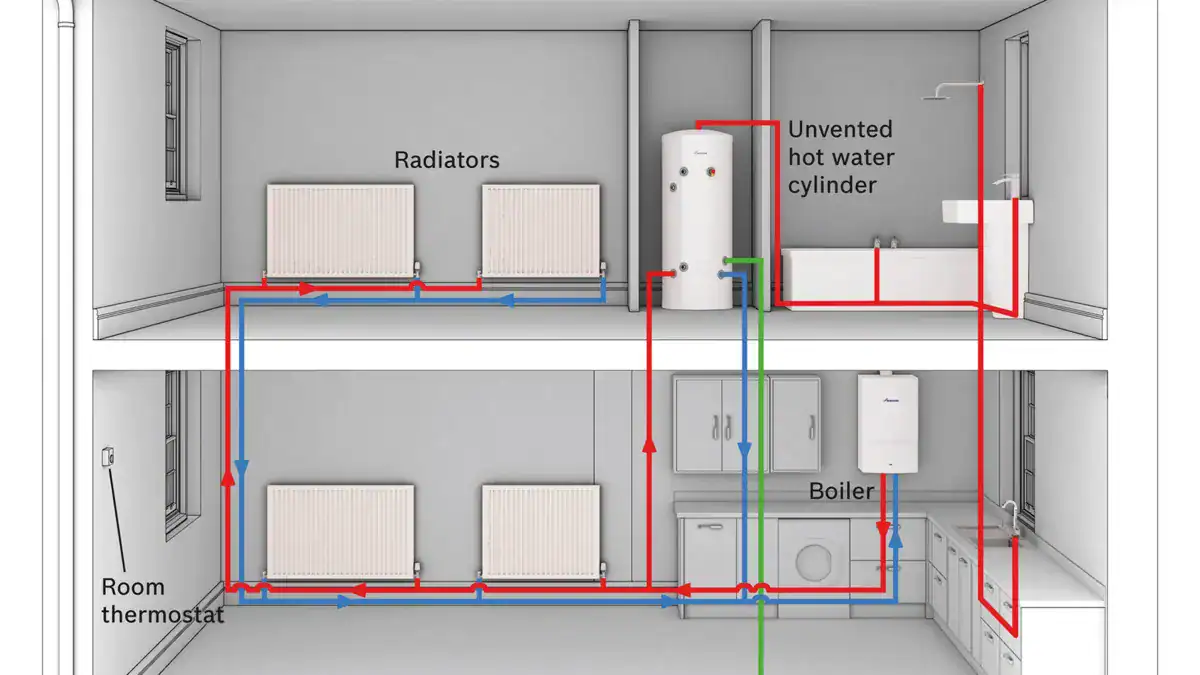
System and heat-only boilers heat a stored cylinder of hot water rather than providing it on demand. Their size is therefore based mainly on how much heat your home needs on a cold day, with an allowance for reheating the cylinder.
That figure comes from a heat loss assessment, which considers the size of each room, wall and loft insulation, windows, floor construction and how exposed the property is. Many three-bedroom homes need somewhere between 12 and 18kW for heating, while larger or less well insulated properties may need more. If you are unsure which type of boiler suits your home, our article on combi, system and heat-only boilers explains the differences.
What affects the size of boiler your home needs?
- Heat loss: older solid-wall homes and properties with single glazing lose heat faster than modern, well insulated homes.
- Bathrooms and showers: the more hot water you use at once, the more output a combi needs, or the more likely a cylinder is the better option.
- Mains flow rate and pressure: this limits what any combi can deliver.
- Radiators: the number and size of radiators reflects how much heat the system is designed to deliver.
- Future plans: an extension, loft conversion or extra bathroom changes the calculation, so mention any plans before your survey.
Across Cambridge we see everything from Victorian terraces around Romsey and Petersfield to new homes in Trumpington and Eddington. The right boiler for each can differ, even where the number of bedrooms is the same.
Why shouldn't you size a boiler by bedrooms alone?
Online calculators often recommend a boiler size based on the number of bedrooms. That can be a useful starting point, but two four-bedroom houses can have very different heating needs. A well insulated new build may need far less heat than a draughty period property of a similar size, and choosing by bedrooms alone is one of the most common reasons boilers end up oversized.
Should you replace your old boiler with the same size?
Not necessarily. Many older boilers were sized generously, and homes have often been improved since with loft insulation, cavity wall insulation or double glazing. Replacing like for like can mean fitting a boiler that is larger than you need.
The opposite can also happen. If you have added an extension or another bathroom since your current boiler was fitted, it may now be too small. A fresh assessment is always worth it.
What happens if a boiler is the wrong size?
An undersized boiler may struggle to bring rooms up to temperature in cold weather, and an undersized combi can leave showers running lukewarm. An oversized boiler costs more to buy and tends to cycle on and off more often, which can reduce efficiency and increase wear over time.
How do we size a new boiler?
When we survey a home for a new boiler, our engineers look at the property, the existing system and how your household uses hot water. That usually includes:
- Checking the existing boiler, pipework, flue position and controls
- Measuring the mains water flow rate where a combi is being considered
- Looking at room sizes, radiators and insulation to assess heat loss
- Talking through bathrooms, showers and any plans for the property
We then recommend a boiler type and size that suits your home, rather than the largest model available. You can find out more about our new boiler installation service, or download our free boiler buying guide.
Frequently asked questions
Is a 24kW combi boiler big enough?
For a flat or smaller home with one bathroom and a reasonable mains supply, a 24kW combi is often enough. In larger homes, or where showers are used one after another, a higher output usually gives a better result.
Is a bigger boiler more expensive to run?
Not directly, because a modulating boiler only burns the fuel it needs. However, a heavily oversized boiler tends to cycle on and off more often, which can reduce efficiency, and it costs more to buy. Our guide to how much a new boiler costs explains what affects the price.
Will a bigger combi improve my shower pressure?
Only if your mains supply can support it. If the incoming flow rate is what limits your shower, a larger combi will make little difference.
Do I need a heat loss calculation for a new boiler?
For system and heat-only boilers, assessing heat loss is the most reliable way to choose the right output. For combi boilers it is still useful, alongside a check of hot water demand and mains flow.
Who can install a new boiler?
A gas or LPG boiler must be installed by a Gas Safe registered engineer, and the installation must be notified under Building Regulations. Oil boilers should be installed by an OFTEC registered technician.
Get the right size boiler for your home
The right size of boiler depends on your property, your hot water needs and your water supply, which is why a survey is always more reliable than a rule of thumb.
Plumbox installs combi, system and heat-only boilers across Cambridge and Cambridgeshire, and is an accredited installer for Worcester Bosch, Vaillant and Ideal. Contact the Plumbox team or call 01223 867038 to arrange a survey and quote.