Unvented Cylinder vs Combi Boiler: Which Hot Water System Is Right for Your Home?
Quick Answer
A combi boiler heats water on demand and needs no cylinder or tanks, which makes it a good fit for smaller homes and flats with one bathroom. An unvented cylinder stores mains pressure hot water and can supply several outlets at once, which suits larger homes, families and properties with two or more bathrooms. The deciding factors are the number of bathrooms, the incoming mains flow rate and how much space you have. A combi is limited by flow rate, a cylinder is limited by capacity.
How does a combi boiler work?
A combi boiler heats water instantly as it passes through the appliance, drawing directly from the cold mains.
Because there is no stored hot water, there is no cylinder and no cold water tank in the loft. That frees up an airing cupboard and often a loft space, and it removes the standing heat loss associated with storing hot water. Hot water is available whenever you want it without waiting for a cylinder to reheat.
The trade-off is that a combi can only heat water as fast as it flows through the appliance. Output is measured in litres per minute, and that figure is shared across every outlet in use at the time. Our boiler buying guide covers how output is specified.
How does an unvented cylinder work?
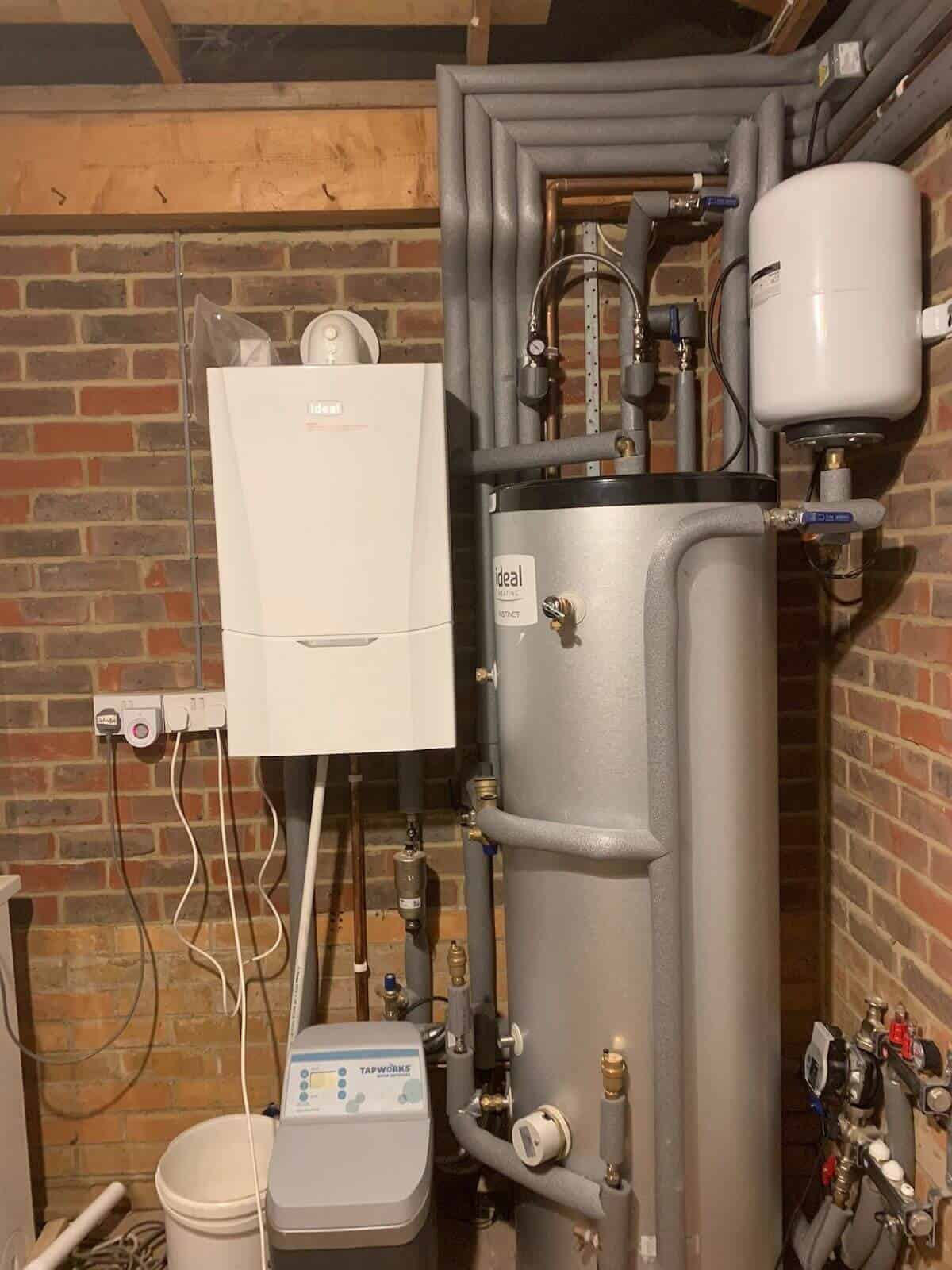
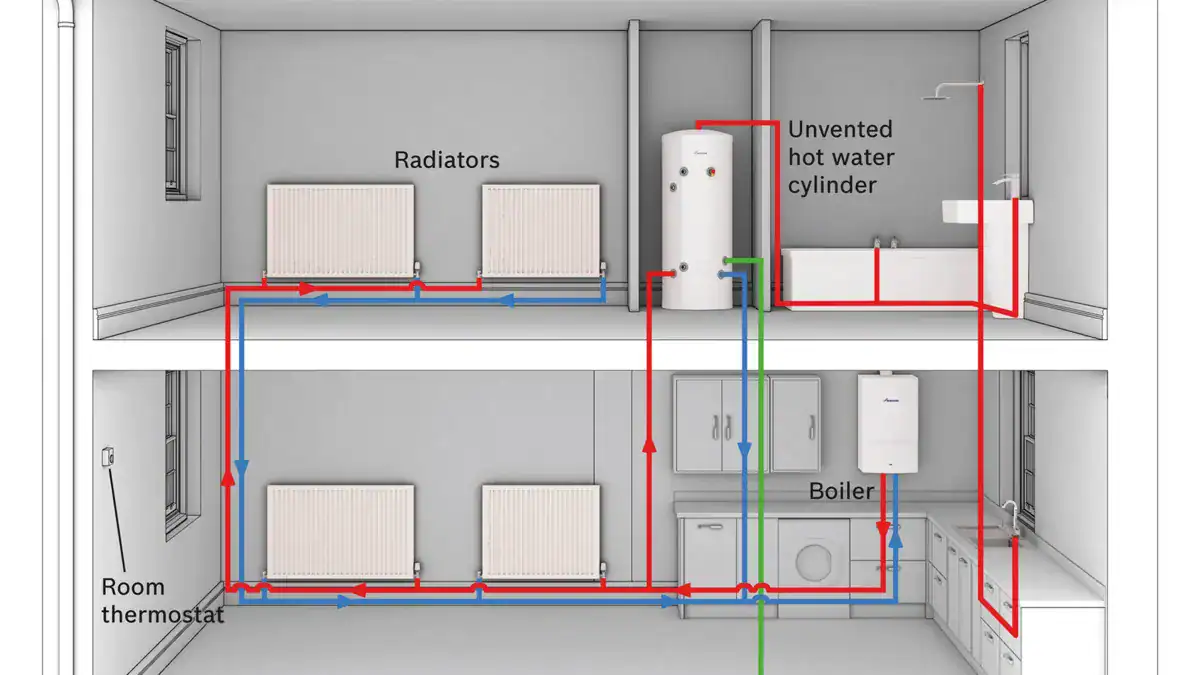
An unvented cylinder stores hot water at mains pressure, heated by a system boiler, a heat pump or an immersion element.
Because the cylinder is fed directly from the mains rather than from a tank in the loft, hot water arrives at good pressure throughout the property. There is no cold water storage tank, and no reliance on gravity, so upstairs showers perform as well as downstairs ones.
The trade-off is capacity and space. The cylinder holds a finite volume of hot water, and once it is used the system needs time to reheat. The unit also needs a suitable location, and unvented systems must be installed and serviced by a qualified engineer because they operate under pressure.
What difference does the number of bathrooms make?
This is usually the question that decides it.
A combi boiler splits its available flow between whatever is running. With one shower on its own, a well-specified combi performs very well. Run a second shower or fill a bath at the same time and both weaken noticeably, because the same litres per minute is being divided.
An unvented cylinder delivers stored water at mains pressure to several outlets simultaneously, so two showers running together is not a problem provided the cylinder has been sized for the household. For a home with two or more bathrooms, or an en suite that gets used at the same time as the family bathroom, a cylinder is generally the more comfortable answer.
Why does your mains flow rate matter so much?
Both systems depend on the incoming supply, but a combi depends on it far more directly.
A combi boiler cannot deliver more hot water than the mains can supply it. If the incoming flow rate is modest, fitting a higher-output combi will not improve performance, because the limitation is the supply rather than the appliance. Our guide on what size boiler you need explains combi outputs in more detail. This catches out a lot of homeowners who upgrade the boiler and find the shower is no better.
An unvented cylinder is less sensitive to flow rate because it stores water in advance, though it still needs adequate mains pressure and flow to fill and to deliver properly.
Measuring the incoming flow rate and pressure is a standard part of any assessment we carry out before recommending a system. It is not a detail that can be assumed from the property type.
How much space does each option need?
Space is often the practical constraint, particularly in older Cambridge properties and city centre flats.
A combi needs only the boiler itself, typically in a kitchen cupboard or utility area. Nothing else is required, and removing an old cylinder and loft tank as part of a conversion frees up genuinely useful storage.
An unvented cylinder needs a suitable location for the unit, which may be an airing cupboard, a loft or a utility room. It also requires a discharge pipe routed to a safe termination point, which is a real design consideration rather than a formality. In a small terrace with no obvious cupboard, that can be the deciding factor.
Which suits different Cambridge homes?
The housing stock across Cambridge and the surrounding villages varies enormously, so there is no single answer. As a general guide:
- Flats and one-bathroom homes: A combi is usually the simpler and more economical choice, provided the mains flow rate supports it.
- Two-bathroom family homes: An unvented cylinder generally gives a better experience, particularly at busy times of day.
- Larger period properties: A cylinder often suits both the demand and the existing pipework layout, though pipe sizing should be checked.
- Extensions and renovations: Worth deciding early, since a cylinder needs a planned location and discharge route.
- Homes considering a heat pump: A cylinder is normally required, as heat pumps do not heat water instantaneously in the way a combi does.
Plumbox works across the locations listed on our areas we cover page, so our engineers are familiar with the property types common to each.
Which is cheaper to run?
Running costs depend more on the whole system than on the choice between these two.
A combi avoids standing heat loss because it stores nothing, which is a genuine efficiency advantage. Modern cylinders are well insulated and the losses are much smaller than they were, but they are not zero.
Against that, a cylinder can be heated at times that suit a cheaper tariff, and it can accept heat from a heat pump or solar thermal input. Insulation levels, controls, how the heating is used and the boiler's own efficiency all affect bills more than the storage decision alone.
Installation cost differs more predictably. A straightforward combi replacement is usually the less expensive job. Converting from a combi to a cylinder, or the reverse, involves more pipework and more disruption than a like-for-like swap.
Can you switch from one to the other?
Yes, in both directions, though the work involved differs considerably.
Converting from a cylinder system to a combi means removing the cylinder and any loft tank, altering pipework and confirming the mains can supply the flow rate you need. It is a popular way to reclaim storage space, but only sensible where the mains supply is adequate.
Converting from a combi to a system boiler and unvented cylinder involves finding a location for the cylinder, running a discharge pipe, and often upgrading pipework to take advantage of the improved flow. It is a larger job, and it is usually done as part of a wider renovation or when a household has outgrown its hot water.
Either way, the assessment matters more than the product choice. We survey the property before recommending anything, as set out on our new boiler installation page.
What should you check before deciding?
A proper assessment should cover:
- Incoming mains pressure and flow rate, measured rather than estimated
- Number of bathrooms and how often they are used simultaneously
- Household size and daily hot water demand
- Available space for a cylinder and a viable discharge route
- Existing pipework sizes and condition
- Whether a heat pump is a possibility in future
- Scale protection, given Cambridge's hard water
That last point matters more here than in many parts of the country. Both systems are affected by limescale, and protection is often a condition of the manufacturer's warranty.
Frequently asked questions
Can a combi boiler run two showers at once?
Generally not to a satisfactory standard. The available flow is shared between outlets, so both showers weaken. If two showers running together is a regular requirement, an unvented cylinder is usually the better solution.
Do unvented cylinders need servicing?
Yes, annually. Unvented systems contain safety components including an expansion vessel and pressure relief valves that must be checked by a qualified engineer. This is separate from the boiler service, though we normally carry out both in one visit.
How long does an unvented cylinder take to reheat?
It depends on the cylinder size and the output of the heat source, but a typical domestic cylinder reheats within around an hour to ninety minutes. Correct sizing is what prevents a household running out in the first place.
Is a combi boiler suitable for a large house?
Sometimes, if there is only one bathroom and the mains flow rate is strong. In most larger properties with multiple bathrooms, a cylinder gives a better result. The number of bathrooms matters more than the floor area.
Will I lose water pressure with a cylinder?
Not with an unvented cylinder, which operates at mains pressure. The older vented systems with a loft tank relied on gravity and gave weak upstairs pressure, which is what many people remember. Unvented systems do not work that way.
Can I keep my existing radiators either way?
Usually, though radiator sizing should be checked against room-by-room heat loss, particularly if the system will run at a lower flow temperature. We assess this as part of a heating system upgrade rather than assuming existing radiators are adequate.
Which hot water system is right for your home?
A combi boiler suits smaller homes with a single bathroom, offers instant hot water and takes up the least space. An unvented cylinder suits larger households and multi-bathroom properties, delivering strong mains pressure hot water to several outlets at once.
For most Cambridge homes the answer becomes clear once the mains flow rate has been measured and the household's actual demand is understood. That is a survey rather than a guess.
Plumbox provides plumbing and heating services in Cambridge, including combi boiler installation, unvented cylinder installation and servicing, and complete heating system upgrades. Contact the Plumbox team or call 01223 867038 to discuss your property and arrange a quote.